
President Trump has created a big moment for philanthropy. The dismantling of USAID and other federally funded programs creates an opportunity for philanthropy to step in and fill the gap. In the US, President Trump’s executive order banning DEI also leaves a space for philanthropy to drive America’s moral compass. We now need evidence more than ever in today’s post-truth world. What role does philanthropy now have in defining how we use evidence to create social change?
An evolution of evidence in philanthropy
The use of data in grantmaking is not new. Strategic philanthropy, popularized by corporate philanthropies in the 1980’s, emphasizes using data-driven for-profit business strategies to tackle social issues [1]. Despite the promise of efficiency, Strategic philanthropy has failed to create impact at scale. Some of the main reasons for its failure were laid out by the Stanford Social Innovation Review around a decade ago:
- Strategic philanthropy often overlooks the time needed to create lasting social change.
- Strategic philanthropy’s “return mindset” undervalues local knowledge.
- Strategic philanthropy approaches tend to lack flexibility. They often don’t adapt to the specific context in which they’re used.
Given these shortcomings, many have shifted to using more participatory, justice-based, and trust-based philanthropy models. These approaches focus on reducing the administrative burden of reporting and shifting grantmaking decisions to the communities being served. Others have leaned more heavily into effective alturism. This approach emphasizes maximizing impact through focusing only on the most effective and neglected problems.
What I have Learned about Measuring Impact
No matter what approach you take to philanthropy, there are many ways we can improve how evidence is used grantmaking. Here’s a list of helpful approaches and tools for philanthropies to consider.
Use causal pathways to identify what to measure
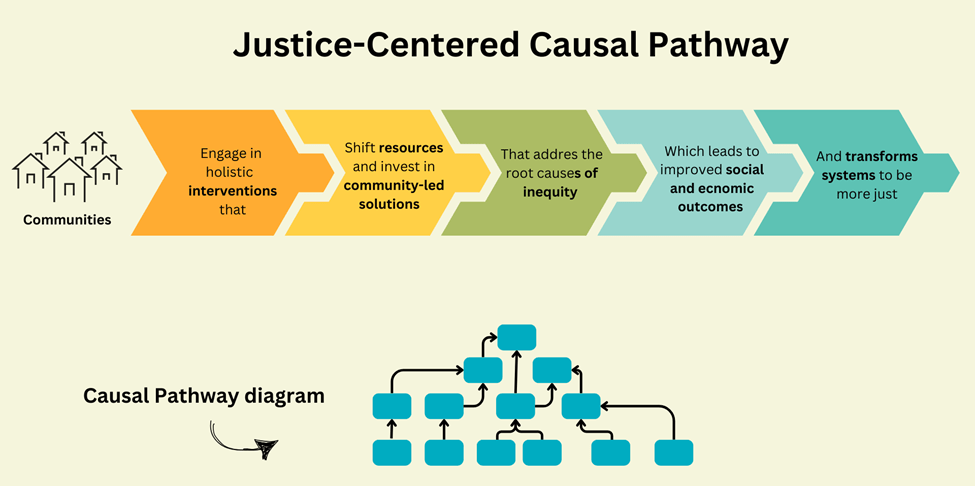
As the saying goes, “we measure what we treasure, and we treasure what we measure.” Only focusing on return on investment (ROI) can overlook what actually matters to today’s philanthropies. But what is the best way to identify what to measure? Causal pathways are diagrams that illustrate how events, factors, and actions link together. They map the chain of events that lead to a specific outcome or impact. Causal pathways can also show changes you can measure in the short, medium, and long term. Many fields use causal pathways. I have found they are especially useful for showing change in complex systems. Below is an example of a high-level causal pathway and what a more detailed diagram would look like.
Center communities in defining what success looks like
Research often treats communities as “subjects” not as partners. One way to center communities and other stakeholders in evidence is through a process called “sensemaking”. Sensemaking is a participatory learning approach that shifts power back to communities to define what success looks like in their context. It works best when many different types of stakeholders (community, government, civil society) come together to share knowledge and identify actions to take. When practiced regularly, sensemaking can foster participatory data and learning cultures in philanthropies. To learn more about sensemaking, see this video.
Use good enough evidence to adapt
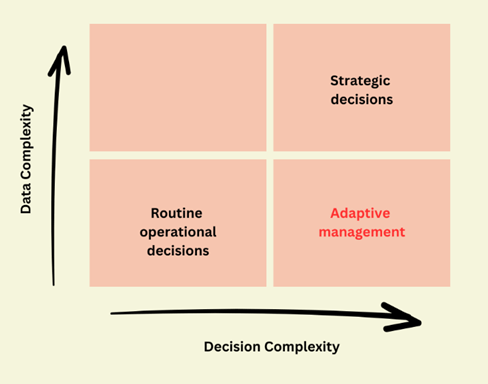
In this era of big data, it is easy to get analysis paralysis. What level of evidence is “good enough” to make a decision with? The answer is – it depends. Adaptive management is the practice of using the best available evidence to make decisions amid ongoing uncertainty. It tends to rely on less complex data to make complex decisions (see diagram below). Do not confuse adaptive management with making ad hoc decisions. Doing adaptive management right requires organizations to create data systems that deliver information quickly. Organizations must also invest in creating a culture of reflection and continuous learning.
Before making any decision, check your internal biases first. The most common one I’ve seen is confirmation bias. This means you look for, interpret, and remember information that supports your existing beliefs or values.
Key Takeaway
Philanthropies are well positioned to take the lead on how evidence is used to create lasting social change. Today’s philanthropies should embrace complexity, be participatory, and be adaptive in how they use evidence to inform their work.
Citations
[1] McClimon, Timothy J. 2004 “The Shape of Corporate Philanthropy Yesterday and Today” GIA Reader, Vol 15, No 3 (Fall 2004). https://www.giarts.org/article/shape-corporate-philanthropy-yesterday-and-today

 The Evidence Reaction
Leave a comment